Over the last few years, most conversations around AI have focused on prompts. The perfect prompt. The latest model. The newest image generator. But as brands and agencies begin integrating AI into their production pipelines, a different question is emerging:
How do we make these results repeatable?
Because generating one great visual is impressive. Generating one hundred visuals that maintain the same style, character, product accuracy, and creative direction is where the real business value begins.
The Problem With One-Off AI Generation
Many teams start experimenting with AI by creating assets manually.
A designer writes a prompt, generates images, adjusts settings and repeats the process. This works well for exploration. But it quickly breaks down when production scales.
What happens when:
- A global campaign needs 50 asset variations?
- A gaming character needs to remain consistent across dozens of scenes?
- A product launch requires multiple formats and localizations?
- Different team members need to reproduce the same visual style?
Without a system, consistency becomes difficult.
And consistency is often what separates experimentation from production.
From Prompts to Production Systems
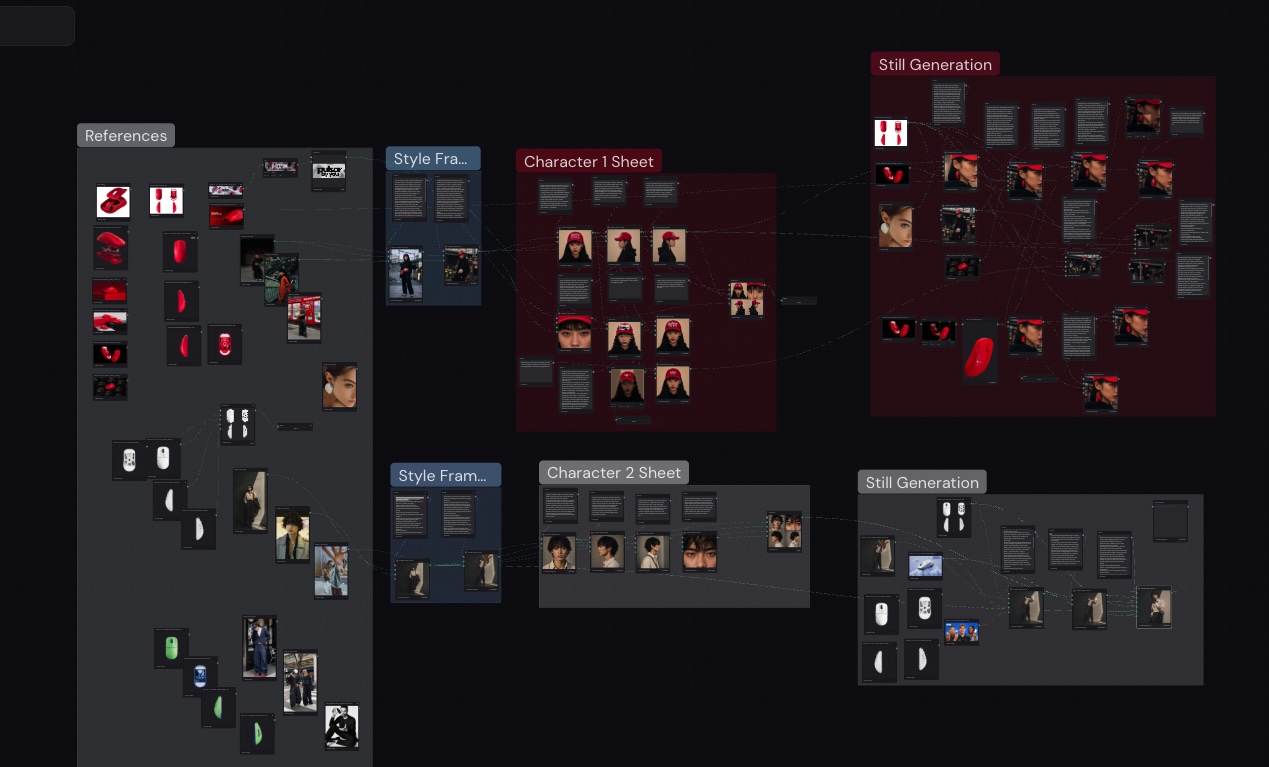
The most advanced creative teams are no longer building prompts. They're building workflows. Tools such as ComfyUI, Weavy, and other node-based AI environments allow teams to transform creative processes into repeatable systems.
Instead of relying on individual prompts, brands can create visual pipelines that preserve:
- Character consistency
- Product accuracy
- Brand aesthetics
- Camera language
- Art direction
- Localization rules
Every output becomes part of a larger system rather than a standalone experiment.
Why Repeatability Matters
Traditional creative production already relies on systems.
Brand guidelines.
Photography guidelines.
Motion templates.
Design systems.
AI production is no different.
The difference is that workflows can now automate much of the technical execution while keeping creative decisions under human control.
For example: A consumer electronics brand might want every new product launch to follow a specific visual style.
Rather than rebuilding the process each time, a workflow can be created that automatically applies:
- Lighting styles
- Product presentation rules
- Camera movements
- Environmental references
- Regional localization requirements
The result is faster production without sacrificing consistency.
Scaling Across Markets
This becomes especially valuable for global brands. Imagine a campaign originally developed for North America that needs localized versions for:
- Japan
- Korea
- Taiwan
- Singapore
The core creative idea remains the same. But visual environments, cultural references, and contextual details need to evolve. With a properly designed workflow, these adaptations become part of the system itself.The campaign can scale across markets while preserving brand identity and creative quality.
This is one of the reasons visual localization is becoming such an important part of modern AI production.
Character and Product Consistency
One of the biggest challenges in AI-generated content is maintaining consistency over time.
A character may change appearance.
A product may lose accuracy.
Materials and proportions may drift.
Custom workflows help solve these problems by introducing structured controls into the generation process. Instead of asking AI to recreate a subject from scratch every time, workflows can reference approved source materials and visual rules that guide future generations. This allows brands to build reusable visual assets rather than constantly starting over.
AI as Infrastructure
Many organizations still view AI as a creative tool. Increasingly, it is becoming production infrastructure. The real value isn't simply creating images faster. It's creating systems that make quality output predictable.
Just as marketing teams use CRM systems to scale customer relationships, creative teams will increasingly use AI workflows to scale content production.
The goal is not automation for its own sake. The goal is building repeatable creative processes that allow teams to focus on strategy, storytelling, and art direction.
The Future of Creative Production
The next generation of creative teams won't be defined by who has access to AI tools. Everyone will have access to those.The advantage will come from who builds the best systems around them.
The brands and agencies that succeed will combine:
- Human creative direction
- Strong visual standards
- Repeatable AI workflows
- Scalable production systems
to create content faster, more consistently, and across more channels than ever before.
Final Thoughts
At Tokyo Visual Lab, we believe the future of creative production isn't about replacing artists, designers, or creative directors.It's about giving them better systems.The most valuable AI workflow is not the one that creates the first image. it's the one that helps your team create the thousandth image with the same quality, consistency, and creative intent as the first. Because great campaigns aren't built from prompts.They're built from repeatable creative systems.
_2026-05-06_08-47-52.webp)